
Engineering the Network
Infrastructure AI
Depends On
Introducing Polarin DCI Wave - the world’s first self-provisioning Layer 1 connectivity solution
High Bandwidth. Ultra-Low Latency. Unlimited Possibilities.


Accelerating AI-Optimized Networking Across APAC with the AI Inference Fabric
AI infrastructure requires the network to function as part of the compute fabric.
The Lightstorm–Arrcus strategic partnership brings advanced routing intelligence into the AI fabric. By combining Arrcus' ArcOS capabilities with Lightstorm's self-serve NaaS platform Polarin, the Inference Fabric makes network an active part of distributed AI compute — enabling training and inference to scale across APAC while maintaining consistent performance and regional data sovereignty compliance.
Distributed & Unpredictable
Multi-directional, bursty, and volatile AI workloads.
AI is Only as Deterministic
as Its Network
AI systems do not operate as isolated applications running within a single data center. They function as distributed, synchronized compute environments where variability is amplified, synchronization is continuous, and even minor inconsistencies can propagate across clusters.
Network behavior directly shapes model performance. What was acceptable in the cloud era – tolerance for fluctuation and best-effort networking – becomes a structural constraint in the AI era.
This is where the network transforms from a background transport layer into a core component of compute.
Beyond Bandwidth: The Metrics That Define AI Performance
Bandwidth and uptime alone do not define performance. In modern AI architectures, latency variance, packet loss, and flow consistency directly determine compute efficiency. The metrics that matter shift from throughput and availability to determinism — from averages to predictable performance under load.
AI performance is defined at the network layer. Lightstorm builds the Deterministic AI Fabric that makes it predictable at scale.
Why is this important?
It is the variation in packet delay over time. Small network fluctuations slow down the entire AI system.
Cloud Workloads
Minor fluctuation tolerated.
AI Workloads
Must be minimal as jitter is amplified across nodes. Consistency > average latency.
Lightstorm –
The Deterministic AI Fabric
Lightstorm's network is a deterministic network fabric, purpose-built for AI.
It integrates high-capacity fiber infrastructure with intelligent software-defined routing that allows real-time path optimization and enables a unified system with guaranteed, stable, cost-effective performance across regions.
Lightstorm's Deterministic AI Fabric is built on two tightly integrated layers that enable distributed AI systems to operate as a unified compute environment.
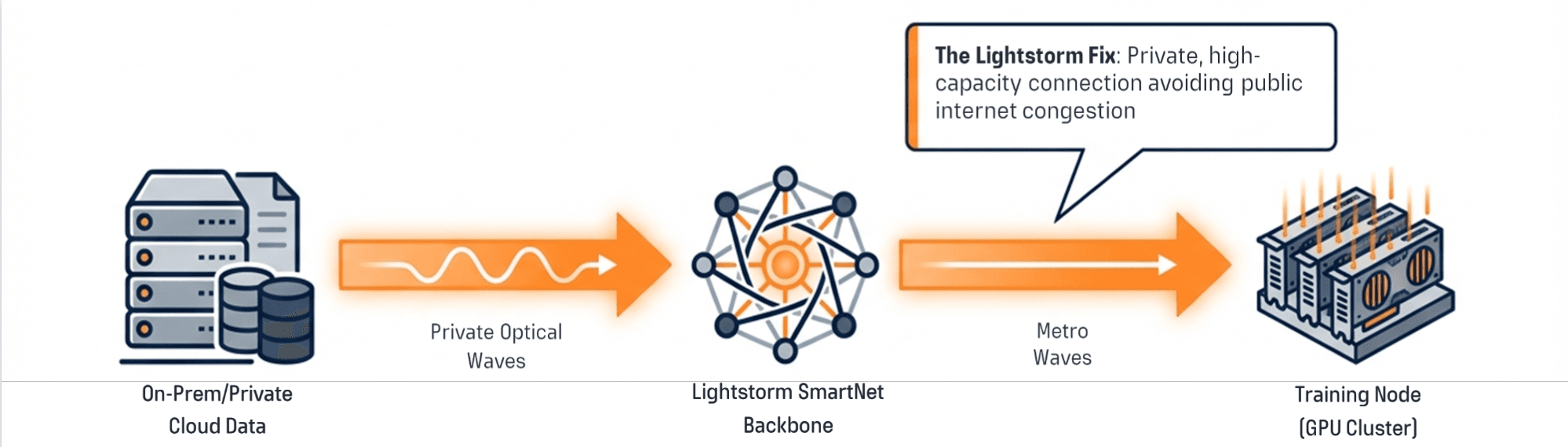
SmartNet AI Fabric is a purpose-built infrastructure for low-jitter, loss-optimized transport across distributed AI zones. It is the foundation designed to power synchronized training and latency-sensitive inference at scale.

Deterministic Performance
- Low jitter architecture
- Tail-latency optimized paths (P95/P99)
- AI-ready routing
AI Corridor Design
- Deep trenching fiber
- Reduced regenerations
- Direct zone-to-zone AI connectivity
Loss-Optimized Transport
- Congestion-controlled paths
- Microburst handling
- Packet-loss minimization
AI Zone Interconnect
- Multi-DC GPU cluster connectivity
- East-West optimized backbone
- High-capacity readiness (400G -> 1.6T)
The shift to AI-native infrastructure redefines what organizations can build. Deterministic network performance becomes the foundation that moves distributed AI from experimentation to production-scale intelligence.
Polarin
in Action
See how Polarin NaaS platform provisions, monitors, and optimizes AI connectivity in real-time.
Lightstorm Enables AI Workloads at Scale
AI workloads place fundamentally different demands on network infrastructure compared to traditional enterprise traffic. Training requires sustained, synchronized, bulk data movement; inference demands real-time responsiveness without performance variance.
AI Training
- Distributed GPU clusters
- Heavy east-west traffic
- Long-running, bandwidth-intensive jobs
- Frequent synchronization across nodes
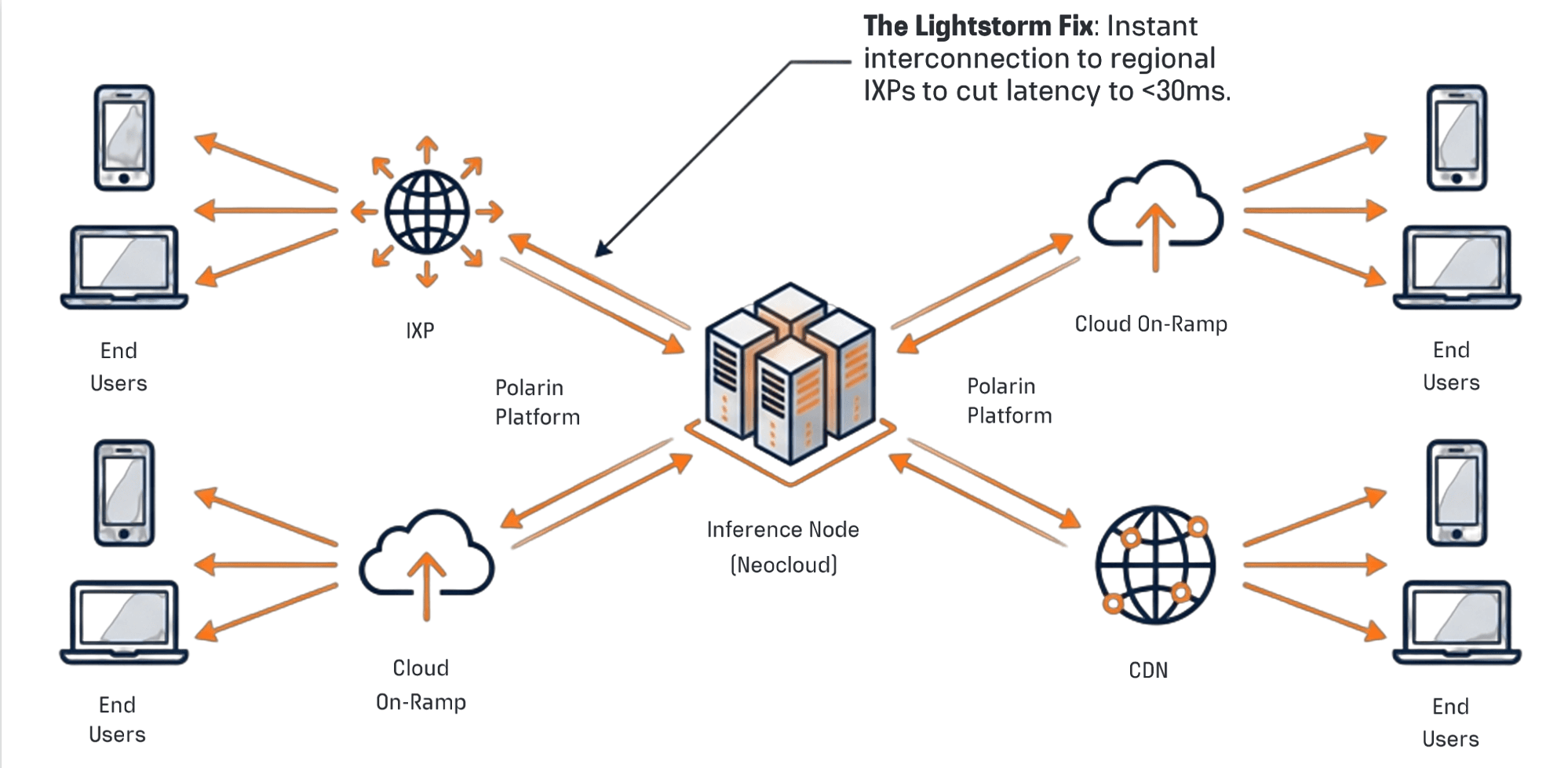
AI Inference
- Real-time or near-real-time
- Distributed deployment across regions
- Mixed north-south and east-west traffic
- Bursty, unpredictable demand profiles
AI Training
- Latency variance (jitter)
- Packet loss disrupts
- Flow completion time impacts
- Congestion spikes reduce
AI Inference
- Tail latency (P95/P99)
- TTFT impacts perceived responsiveness
- Congestion spikes affect consistency
- Cross-region performance variability
AI Training
- Low-jitter physical fabric (SmartNet)
- Loss-optimized transport
- Congestion-aware traffic engineering (Polarin)
- Consistent performance
AI Inference
- Tail-latency-optimized routing (SmartNet)
- Real-time performance monitoring (Polarin)
- AI-aware provisioning
- Predictable cross-zone and edge connectivity